Kalpana Sunder
21-Jul-2026
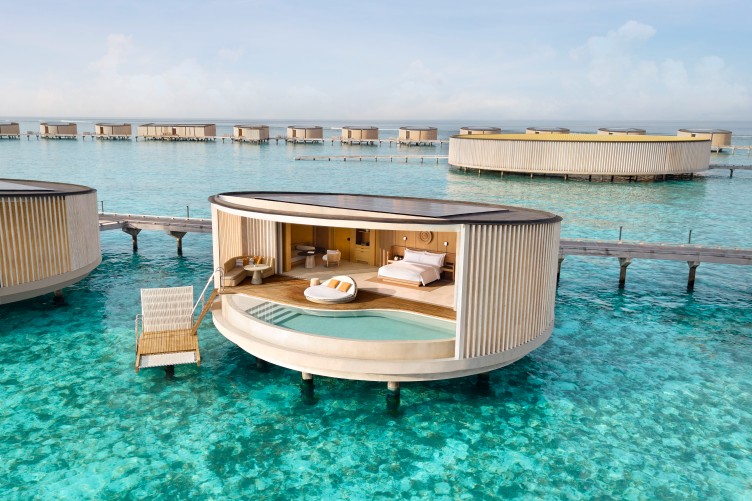
The Maldives has become an unlikely laboratory for some of the best architects and designers from across the world.
For decades, the Maldives, the archipelago of 1200 islands and 26 atolls, with a range of luxury resorts for all budgets, sold a singular fantasy: turquoise lagoons, overwater villas, and Robinson Crusoe-style escapism. But beyond the postcard perfection, a quieter transformation is taking place.
Across the archipelago, some of the world’s most compelling hospitality design is unfolding on tiny islands scattered across the Indian Ocean. The Maldives has become an unlikely laboratory for some of the best architects and designers from across the world. Freed from urban constraints and working in some of the planet’s most spectacular natural settings, they are reimagining what tropical luxury can look like. The result is a collection of resorts that are as much about architecture, sustainability, craftsmanship, and design philosophy as they are about beaches and sunsets. Many luxury resorts are commissioning bespoke furniture, contemporary art, textiles, ceramics, and lighting.
What makes this evolution particularly fascinating is that it is taking place in one of the world's most fragile environments. Architects have developed innovative ways to build overwater villas without damaging coral reefs, using prefabricated structures, floating foundations, and carefully designed boardwalks that minimise disturbance to the seabed. Increasingly, designers are moving away from generic luxury, embracing natural materials such as thatch, coconut timber and locally sourced stone, while incorporating passive cooling, renewable energy and low-impact construction methods that tread lightly on delicate island ecosystems. Many luxury resorts are also commissioning bespoke furniture, contemporary art, handcrafted textiles, ceramics and lighting, creating destinations where design is integral to the guest experience.
At The Ritz-Carlton Maldives, Fari Islands, Australian architect Kerry Hill's signature minimalism is on full display. Circular villas appear to hover above the lagoon, their graceful forms inspired by the rhythm of the ocean, the cycle of life and traditional Maldivian architecture, while the sculptural walkways pay homage to the islands' iconic bodu beru drums. The circular motif continues throughout the resort – from the ring-shaped spa and infinity pool to the Mystic Garden, centred around a magnificent 100-foot banyan tree.
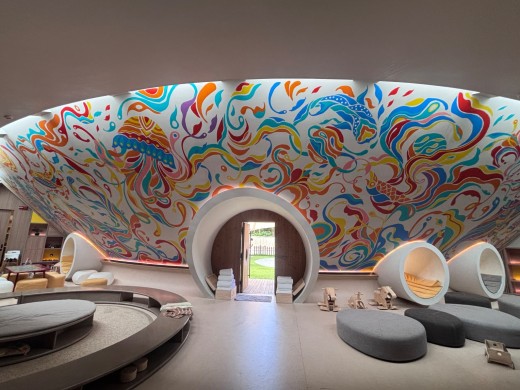
(Kids' Centre at Ritz Carlton, Fari Islands)
The architecture is contemporary yet understated, allowing the extraordinary landscape to remain the focal point. Innovative prefabricated construction techniques ensured minimal disruption to the surrounding ecosystem during development. At the same time, the interiors celebrate craftsmanship through furniture, rugs and textiles created by both Maldivian and international artisans. Cross-laminated timber, sourced from sustainably managed European forests, was used extensively for the roofs, walls and structural columns. Inside the villas, floor-to-ceiling sliding glass doors dissolve the boundary between indoors and out, immersing guests in uninterrupted ocean views.
The landscaping is equally thoughtful, with hundreds of carefully selected native plants and adopted trees enhancing the natural environment. Sustainability extends well beyond the architecture: energy-efficient air-conditioning systems, intelligent lighting and passive cooling strategies reduce the resort's carbon footprint. Public spaces are naturally ventilated by prevailing sea breezes, significantly reducing the need for mechanical cooling.
The circular Ritz Kids Club, emerging from a landscaped mound, resembles a hobbit's house tucked into the island. Inside, a monumental mural of marine life by a Maldivian artist introduces young guests to the rich biodiversity of the surrounding ocean.
Art is woven into every corner of the resort. Suspended above the bed in my villa is an intricate wheel crafted from bamboo, rattan and steel, handwoven by a Taiwanese artist. Across the property, more than 100 artworks add layers of meaning and symbolism. My favourite is Bloom by Sebastian Di Mauro, a polished stainless-steel sculpture near the water's edge that evokes the unfolding bud of a lotus flower. Equally striking is the vibrant mural of sea creatures and abstract forms at the children's centre, painted on site by a Maldivian artist, celebrating the islands' unique marine ecosystem.
At Patina Maldives, Brazilian architect Marcio Kogan brings a distinctly modernist sensibility to the tropics. Clean lines, expansive glass walls and seamless indoor-outdoor living create a serene architectural language that feels effortlessly contemporary. Natural materials such as rattan, soft timbers and textured stone are paired with a restrained palette of warm neutrals, resulting in spaces that are sophisticated without feeling ostentatious. More than a conventional island resort, Patina feels like a design retreat—where architecture, art and nature exist in quiet harmony.
The award-winning St Regis Maldives Vommuli Resort draws its design inspiration from Maldivian natural landscapes and blends traditional motifs with organic forms. The resort is inspired by Maldivian marine life in its design, with villas that resemble manta rays with their mouths wide open, the Whale bar inspired by the shape of a whale gliding in the waters and the overwater Iridium Spa resembling a seashell.
Nestled in the Baa Atoll, Nautilus’s interiors, with curves and arcs, are inspired by a shell with organic circles and spirals seen throughout the property using kapur, pine, and acacia wood. Villas have high-pitched circular ceilings with wooden beaded chandeliers; public outlets have lantern windows, and the artworks are also nautical in theme.
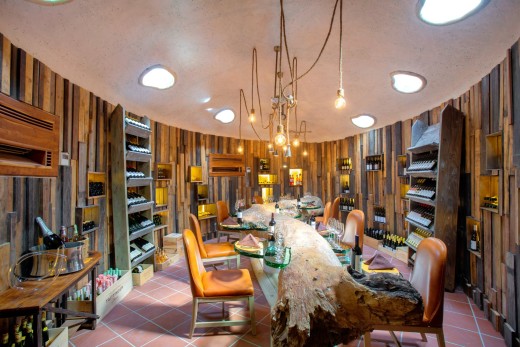
(Underground Bar at Gili Lankafushi)
Then there is Gili Lankanfushi, in the North Male Atoll, with rustic overwater villas with thatched roofs, vast decks and bathrooms with a view, which is largely built from natural materials and the ultimate in barefoot luxury. Every piece of furniture here has been custom-made by craftsmen using recycled materials. Hanging lights have been crafted from bamboo prawn catcher baskets. Keychains, door handles, handles on drawers and cabinets, wall hangings – everything is inspired by the ocean and its creatures. The wooden tables in the room come carved with stars, and the wooden headboards of beds have been crafted from recycled teakwood. I love the lampshades made of recycled wire mesh moulded into sea creatures like turtles and fish and the turquoise accents.
All the buildings are constructed using plantation teak, palm wood and bamboo, and recycled telegraph poles have been used as stilts for the overwater villas. Weathered wood, open-air spaces and handcrafted details create an atmosphere that is deeply connected to the sea and sky beyond. The underground wine cellar has a centrepiece table which is made from a log of wood which washed ashore during the 2004 tsunami.
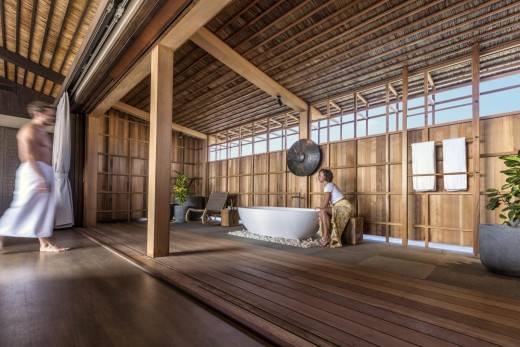
(Kudadoo Maldives, Residence Bathroom)
Kudadoo’s Japanese-inspired minimalism by Yuji Yamazaki using teak and cedar wood has geometric designs with solar panels on the rooftop of the retreat, with Tasmanian oak floors and self-cooling systems. The ocean residences that fan out from the elliptical boardwalk have overhang roofs, umbrellas, and canopies to provide at least 5 hours of shade during the day. Native plants on the island like sea lettuce, ironwood, coconut palm, beach hibiscus and screw pine have been retained.
Joali Being, another spectacular, well-living Maldivian resort in Bodufushi, was designed by Autoban studio around the theme of biophilia – being around nature – and everything here blends seamlessly into the ocean or the jungle. The organic-looking Gate of Zero sculpture, designed by Seckin Pirim, welcomes you to Joali Being, inspired by the whirling dervishes of Turkey, with the artwork lit with surface-mounted light sources. The villas are reminiscent of Indonesian temples with thatched roofs and clusters of rattan timber lighting structures.
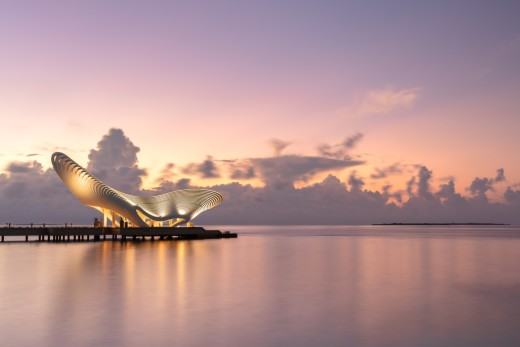
(Joali Being)
Soneva Jani’s sun-bleached wooden timber villas built on multiple wooden rafters use coconut wood, recycled glass, teak plantation wood, cedar and parasitic vines. The 'Gathering', which houses the resort's restaurants, spa, kids' area, wine reserve, etc., stands out with its extravagant roof, specially designed with 104,000 pieces of red river gum shingles. The main lounge has sculptural installations that resemble jellyfish suspended from the ceiling. The dining venue called Crab Shack uses driftwood and reclaimed wood and is an homage to Maldivian craftsmanship.
Luxury in the Maldives is no longer being expressed through excess alone but through thoughtful integration with nature. Most resorts are adopting a philosophy of blending into the landscape rather than dominating it using low-rise buildings and natural materials. As travellers become more design-conscious, the Maldives is offering something unexpected. It is no longer simply a destination for honeymoons and beach holidays. It has become a showcase for some of the most innovative ideas in hospitality design.
Cover Image Credit- The Ritz Carlton Maldives, Fari Islands